You wouldn’t believe the scream I screamed when I found out there was a new Sense and Sensibility adaptation on the way starring not only Daisy Edgar-Jones as Elinor Dashwood, but also George MacKay as Edward Ferrars. Alright, maybe it was more like a rather dramatic sigh. They are two of my favourite actors, my love for George goes all the way back to Peter Pan (2003), a movie I was obsessed with as a child, and Daisy is of course the most perfect Marianne any fan of Normal People could ever have hoped for. And now these two are giving us a new Sense and Sensibility adaptation, what a world we live in! So, it is only natural that I had to revisit the book to prepare for the movie, and I shall take you along for the ride.
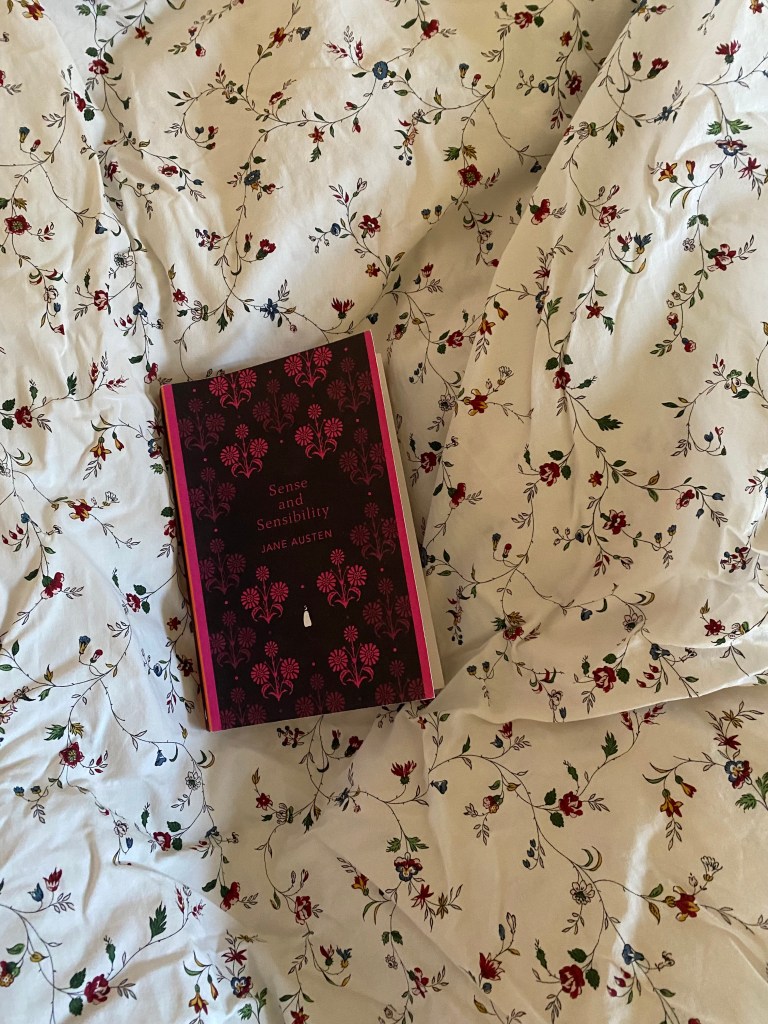
Previous to this reread, I had only read Sense and Sensibility once, as a teenager, in German. Therefore, a refresher was indeed highly necessary. I remember enjoying it back in 2015, but it didn’t leave a lasting impression, exactly. When a dear friend showed me the adaptation starring Emma Thompson a couple of years ago, I was genuinely surprised by the plot. Then again, that might be due to my horrible film memory and not the quality of the book.
Anyway, I wasn’t sure what to expect from Sense and Sensibility, given how little I remembered from the plot. I can tell you this much straight away: Reader, I loved it!! It might be my new favourite Jane Austen novel, dethroning Pride and Prejudice, which I am secretly very pleased with, for Sense and Sensibility is a less obvious and more sophisticated choice. No shade on Pride and Prejudice, though, it remains a masterpiece.
In case you haven’t read Sense and Sensibility yet, it centres on two young sisters, Elinor and Marianne Dashwood, whose father dies, leaving them somewhat impoverished. Okay, that might be a bit of a stretch, they can still afford some servants, but have to downsize to a cottage in Devon (the horror!). They have a young sister whose name has already escaped me again, that is how utterly unimportant she is (no shade, she is no doubt a lovely girl, she just doesn’t get the chance to shine. someone start a petition for a sequel focusing on her!!). You could venture to say that while Elinor is the more rational of the two elder sisters, and Marianne is more impulsive, they both have a great many emotions and over the course of the book find many obstacles in the way of them pursuing their great loves.
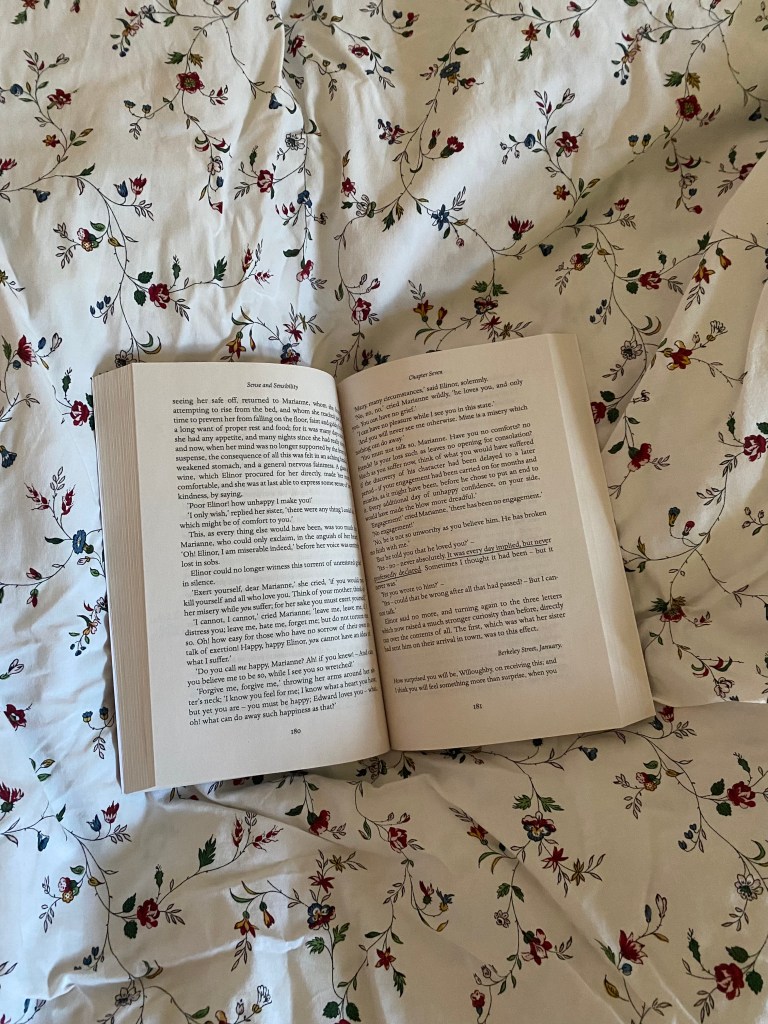
As this is a Jane Austen novel, the writing is of course sublime. No one wrote irony like her. She is throwing shade at people left, right, and centre with such skill that you will find me giggling while reading all the time. Austen’s plots are usually pretty straightforward and there isn’t a lot of action, as is also the case in Sense and Sensibility, but you won’t be bored, because her writing is so great and because every book is full to the brim with the kind of scathing societal observations and criticisms that leave you gasping and you will be greatly entertained nonetheless. Also, she doesn’t go in for lengthy descriptions, unlike some other great authors (looking at you, Mr Dickens). This makes her novels surprisingly easy to read, and so I found myself a good chunk into Sense and Sensibility in no time at all.
I especially loved reading about the relationship between Elinor and Marianne, how the latter is much more like their mother, which means the former usually has to be the sensible, grown up one. Yet Elinor is also confident, and sure of her feelings. I found her to be a very romantic character, which I hadn’t expected, given her strong orientation towards responsibility and logical thinking. Marianne, on the other hand, often annoyed me a bit with her irresponsibility and childlike exertions. But then she won me back over in the latter part of the book, when she has to do quite a bit of emotional growth and then I felt like a grumpy old woman and bad for ever having thought poorly of her. A quote I underlined that I think sums up the difference between Elinor and Marianne the best is this:
“She (Elinor) knew that what Marianne and her mother conjectured one moment, they believed the next – that with them, to wish was to hope, and to hope was to expect.”
It’s an equally lovely and dangerous disposition to have, so let’s just say Marianne and her mother are lucky to have Elinor. Now, in terms of the male characters, I felt a tad conflicted about them. There will be slight spoilers here, but this is a Jane Austen novel, you usually know who their suitors will be the moment they first appear on the page. I had slight trouble warming up to Colonel Brandon, who seems like a nice enough gentleman, but so reserved that he simply fell a bit flat for me. I could not tell whether he and Marianne would be well-matched, because he was so restrained, especially in comparison to her. Now, one might argue that this is exactly what makes them a great couple, and that his restraint was partly due to the fact that Marianne was evidently otherwise involved already. I just wish he had become a bit more passionate towards the end, when it had become clear that Marianne really might end up being his wife.
Edward Ferrars, on the other hand, I loved. Very mysterious and intriguing, that one. Also a bit old for our dear Elinor, by today’s standards, but the book is set a couple hundred years ago, so I just tried to block out his age, which worked semi-well. I was genuinely curious to learn about his engagement, and it of course all seemed tragically impossible that Elinor would get her happy end, but you best believe I cheered for the two of them when that loathsome Lucy Steele was finally out of the way. Good riddance to her! The same goes for Willoughby, of course. Off with his head!! (Just kidding. Sort of.) I was so enraged when he sends that hideous letter to Marianne, pretending to never have made her believe he loved her, I was forced to write down some expletives next to it in order to let off some steam.
What struck me the most upon rereading Sense and Sensibility is Austen’s talent to show the restraints these people had to live with. It should go without saying that her characters are among the fortunate ones in 19th century Britain, because if Mr Dickens (or my history teachers) is to be believed, life could easily be pretty miserable back then. But in the world of Austen’s writing, the worst thing that can happen to you is being betrothed to someone you are ill-matched with (unless you are one of her heroines, in that case, you are sure to get the guy you have set your eyes on). But if we pause and think about it for a second, that already seems like a pretty horrible fate to me. Imagine not being able to choose if you want to marry, or who. Austen never fails to make it very clear that this is a society based on pretence, status, and money, and although Elinor and Marianne both get their happy endings, there is always the clear implication that not everyone is as lucky as them.
And all of this works because Jane Austen is just so damn good at what she does. She writes about love and longing like it’s no one’s business, and she gets me every time. There’s this dialogue between Willoughby and Elinor, after he has come back to his senses (THE FOOL!!!!) and regrets having given Marianne up (to put it mildly), that I would maybe like to get tattooed on my forehead, it hits that hard:
Elinor: “She can never be more lost to you than she is now.”
Willoughby: “But she will be gained by some one else.”
LORD ALMIGHTY. In just one exchange Jane Austen perfectly showcases what is so utterly rotten at the core of Willoughby’s character. He played with Marianne’s love and affection, until he didn’t want her anymore, and now is plagued by regret due to the knowledge that someone as pure and passionate as Marianne will ultimately belong to another. The man can only love selfishly, and deserves nothing but pity. Everyone clap for Miss Austen, because what a gift she gave us with her writing!!!
Ultimately, I just found Sense and Sensibility to be so very readable that I at times forgot I was reading a centuries old classic. The pacing was great, as was the character development and the ending, and maybe I should not be so surprised that a much beloved classic turns out to actually be good, but let me tell you, that hasn’t always been my experience. This was a joy to read, and I would highly recommend it to anyone who enjoys love stories, great writing, lots of wit, and is a romantic at heart. Now all that Daisy Edgar-Jones and George MayKay must do is deliver career defining performances and I shall be utterly happy. No pressure, guys.

 lou's library
Leave a comment