I’ve always been fascinated by history and at the same time nothing frustrates me more than the fact I will never know everything about a country’s history, or come even close to. There’s just so damn much of it. This is why I think sometimes it can be helpful to go back to (or start with, if you’re new to the topic) the basics and get an overview of what has been going down. Then you can decide which periods you would like to learn about in more depth. And this is where The Shortest History Of England by James Hawes enters the chat.
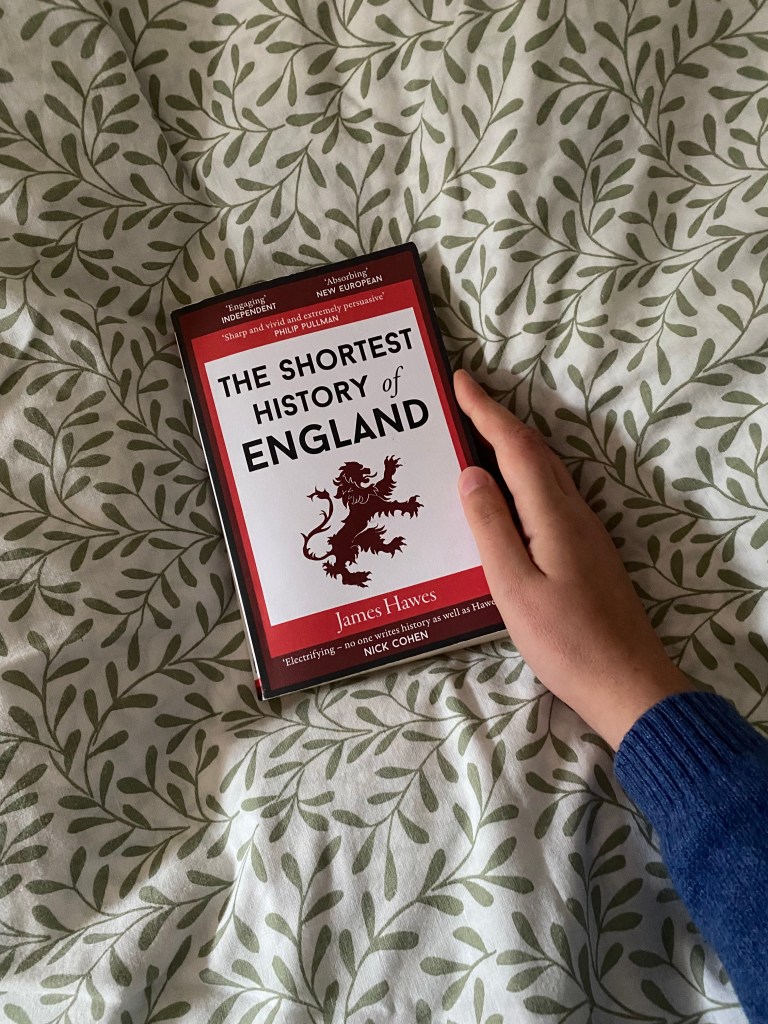
The title is obviously quite catchy and I imagine draws all those in who just want a quick history lesson to better their chances at the next pub quiz. And also people like me, who like the idea of someone telling them which of the shit that has gone down in England in the past 2000 years is actually worth learning about. With just over 260 pages, The Shortest History Of England really is short. I read it in a single day (that was spent mainly on trains, but still you can totally do that rather easily). But to be quite honest with you, I’m not sure how I feel about it.
Is knowing a little better than knowing nothing?
I think it’s totally reasonable to provide those of us who want to learn about English history but don’t have the time or energy to read a 1000 page tomb (that still wouldn’t cover everything) with a book that will give us the bare minimum of information. Knowing a little is surely better than knowing nothing at all, am I right? Yes, but also maybe not.
What sits uneasily with me is that in order to cover even just the basics, major historical events sometimes get no more than a single sentence. If they receive an entire page, then that’s already quite astonishing. But when you’re breaking things down this heavily, you have to leave out things. By reading this book you agree to this. Otherwise you perhaps shouldn’t sign up for a book like this. I just worry that important connections between events get lost in between the simplicity.
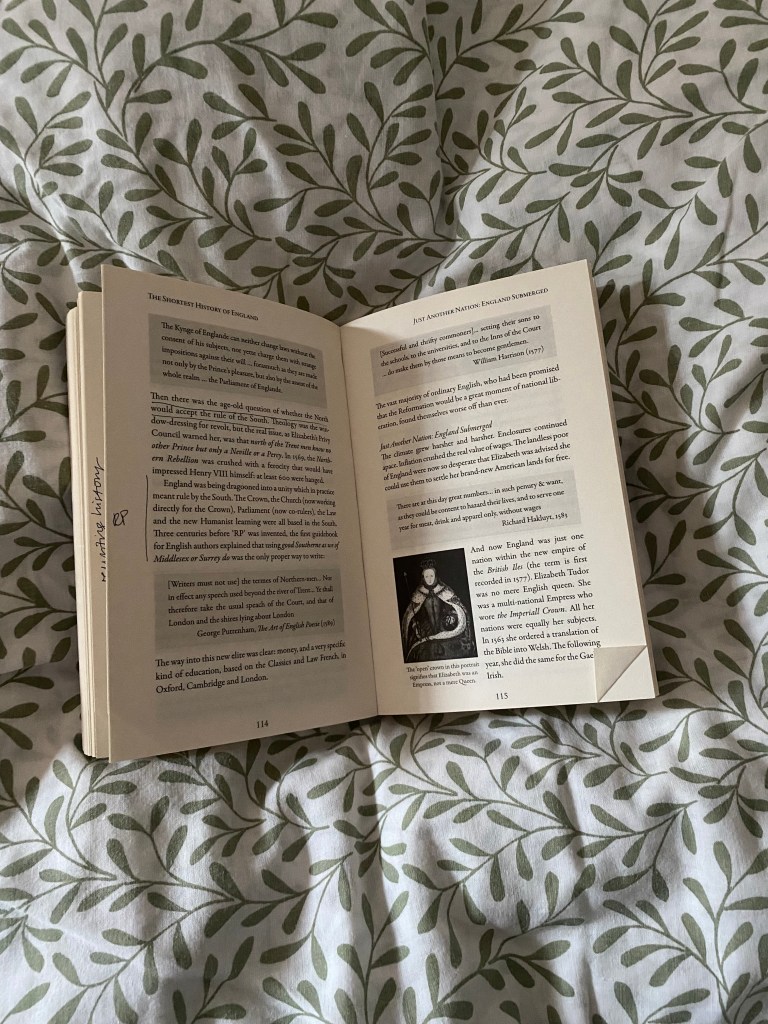
History is tangled up, it consists of centuries of events that all interconnect, and in order to properly understand why something happened, you must be able to grasp these connections. I think James Hawes did his best to show these interconnections, but he couldn’t do so every time it might have been necessary, because then his book would have gotten too long.
It’s short but not easy
Another point of criticism I have is that even though this is supposed to be a short history, it by no means is an easy one or necessarily one for beginners (which it never explicitly states to be, but I do think most people who want to get a broad overview would be beginners). There were chapters of English history I had never learned about before and thus knew little about. I struggled to follow the author’s thoughts at points, because (at least for me) there weren’t enough explanations and descriptions to guide my understanding. So, in its brevity, The Shortest History Of England failed to make me understand certain chapters of the book. I noticed this was much less a problem during chapters dealing with a period I already knew about.
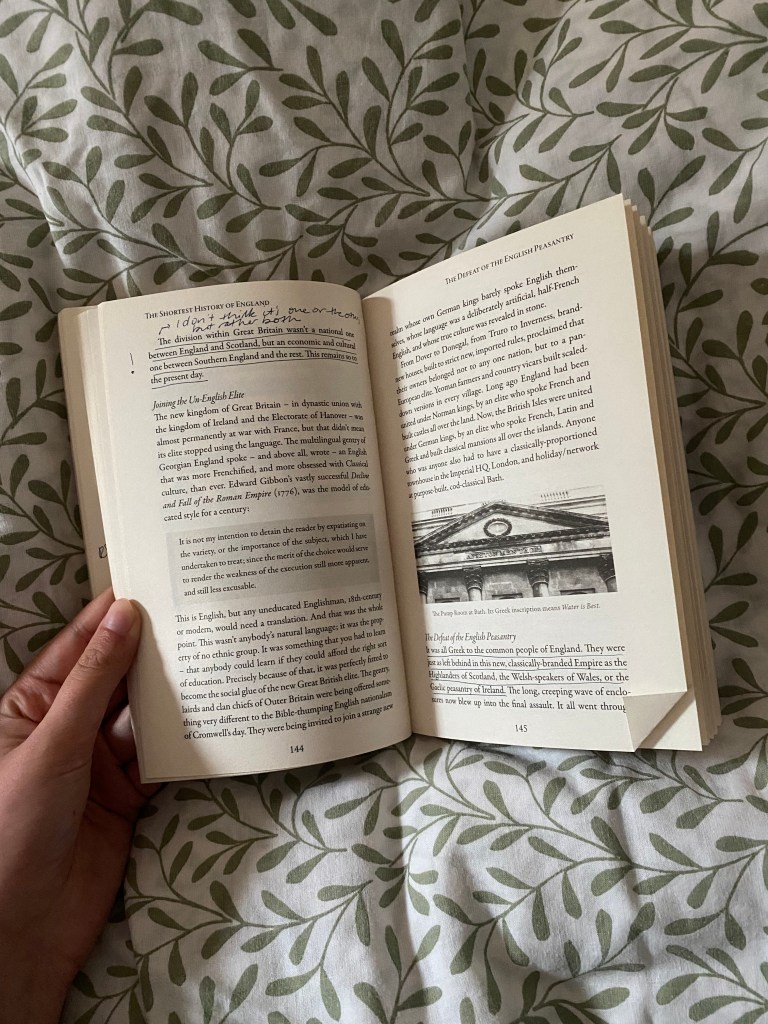
During those chapters, however, I felt frustrated at times because I felt that highly complex subject matters weren’t given the space they would have needed to really do them justice. Again, that’s the price to pay for attempting to write a really short book. At that point I started to wonder if the concept in itself was a sensible one.
Great graphs and illustrations
At the same time, the book is full of helpful illustrations and graphs to explain developments and causes of events in a way that reminded me of schoolbooks. I did find this a great way of illustrating important points and moments in English history. I guess this tension between breaking things down and doing them justice is inevitable with a book like this.
If you truly take The Shortest History Of England as your starting point into English history, then it can work as a guide for you to find out which parts you want to learn about more. But I fear that if this is your one and only English history book, you will be left with a poor sense of the connections between the events and how England developed into what it is today.
I know this is a bit of a mixed review, but I do think there are readers out there who would benefit from this book. I guess the fact that I have studied British Studies turns this into quite a personal subject area that matters greatly to me, which is why I am likely more critical than someone else might be. I do hope James Hawes will write similar books for Wales, Northern Ireland and Scotland, as leaving it at England seems like exactly the kind of English dominance the other countries have been fed up with for centuries.
If you’ve read The Shortest History Of England, do let me know your thoughts! I need to know if I’m the only one who feels so conflicted about it. If you’d like more reviews, I have one about Rebecca by Daphne Du Maurier (which I loved) and while we’re on the subject matter of English dominance, here’s a blog post about great books by Irish authors. Happy reading!


 lou's library
Leave a comment