A few years ago in university, I had to participate in a debate, arguing that art can never be separated from the artist. Since then, I’ve been thinking about this topic a lot. So when I came across Monsters – What Do We Do With Great Art By Bad People? by Claire Dederer, I instantly knew I had to read it. And when I did, I highlighted so many passages and suddenly had so much new input, writing a review on it was a no-brainer. So, if you too are interested in the difficult topic of consuming art by people who aren’t exactly great humans (to put it midlly, in most cases), then look no further!
Disclaimer: I’m not sure if a non-fiction book can be spoilt, but I will be discussing the contents of this book in this blog post. So, if you want to avoid any spoilers, come back once you’ve read the book!
A Short Summary
Claire Dederer approaches the subject with a lot of care and skill. From the outset, it is obvious she has thought a lot about the question of whether it is possible (or recommendable) to consume something created by bad people. To help her illustrate her points, she focuses on one or a few of such “bad” artists in each chapter. Some of the examples she uses are Woody Allen, J K Rowling and Michael Jackson. That doesn’t always mean that she goes into much detail about these people’s actions. She instead uses them to argue her case, or often to just help her articulate her thoughts.

She also dives into the meaning of the word monster, and notions of nostalgia, memory, and moral ethics also come into play over the course of the book. She uses examples from her own life, both in that she discusses controversial artists whose works she really adores and in that she explores whether or not she herself falls into the category of monster (that might sound absurd right now, but I assure you it makes sense in the book).
What I Love About Monsters
I was really surprised about how many perspectives Claire Dederer includes in this book. For example, she dives deeply into the gender dimension of the artistic genius, and how very often male artists get away with monstrous behaviour because it is seen as part of their inherent genius. Female artists rarely receive the same treatment, though (and not that they should, monstrous behaviour shouldn’t be justifiable by anything like gender). Dederer writes poignantly:
This idea of the artist outside the norms of society can be anesthetized or smoothed or made pretty in the image of the free spirit, the Byronic hero. Once again, this image is only available to certain people, who happen to be men.” (page 105)
I had never thought about the different treatment men get compared to women (and other gender minorities) when it comes to what sort of behaviour we accept from them (although I should be wise enough by now not to be surprised). It was a fascinating new angle to the entire question for me.
Another aspect that the author describes really poignantly is that we all have different perspectives that we bring to the table. I grew up listening to The Beatles, so I have a stronger emotional attachment to John Lennon than someone who has only ever listened to The Rolling Stones. And these feelings are loaded with nostalgia and memory, as Dederer argues. This means I can’t always think rationally or detangle my thoughts from my emotions, so when I learn that John Lennon beat his wife, my reaction to that will probably be different from somenoe who doesn’t care about the music of The Beatles. I just think that’s important to keep in mind when discussing the topic, particularly in the age of cancel culture (another topic discussed in the book). Let’s try and be kind to one another, even if someone consumes art by someone you personally refuse to support in any way.
This willingness to be gentle and open is one of my favourite aspects about Monsters. With a topic as hefty as this, it would have been so easy for Claire Dederer to demand we all do better and let go of our silly emotional attachments to the works of rapists and abusers. Instead, she takes a step away from the idea of individual responsibility and declares that what you consume as a singular person isn’t going to make a difference:
The fact is that our consumption, or lack thereof, of the work is essentially meaningless as an ethical gesture.” (page 241).
Now, I don’t think that is to say that if you feel better by not consuming someone’s art, you shouldn’t go ahead and do that. By all means, do whatever feels right to you! But I think that, as a consequence, if listening to your favourite album, even if it is by an objectably bad person, makes you feel better or in a way no other album does, then that’s okay and you don’t have to pretend otherwise.
What Surprised Me About Monsters
That’s also what I didn’t expect Monsters to do. When I first saw the book is separated into chapters about people who fit the “monster” category, I thought the author was going to discuss each one and declare whether or not it is okay to still consume their work. Part of me wanted that to be the case. I wanted someone to take the responsibility off my shoulders and just tell me if I can still enjoy Harry Potter in this day and age. But Dederer doesn’t do that, and I think that’s brilliant. She gives us all her complicated thoughts on the subject and the people, let’s us know what she’s struggling with, how she feels. She has opinions, and lots of them, but she doesn’t come to a definitive conclusion for all these case studies. Instead, by the end of the book, she criticises capitalism for passing the responsibility to the consumer, to us as individuals. As mentioned above, she doubts we have much of an impact or that it should be our burden to carry. So I guess, in a way she does tell us it’s okay to still consume art by bad people. But she does so subtly, leaving room for thought and nuance, and I really appreciate that.
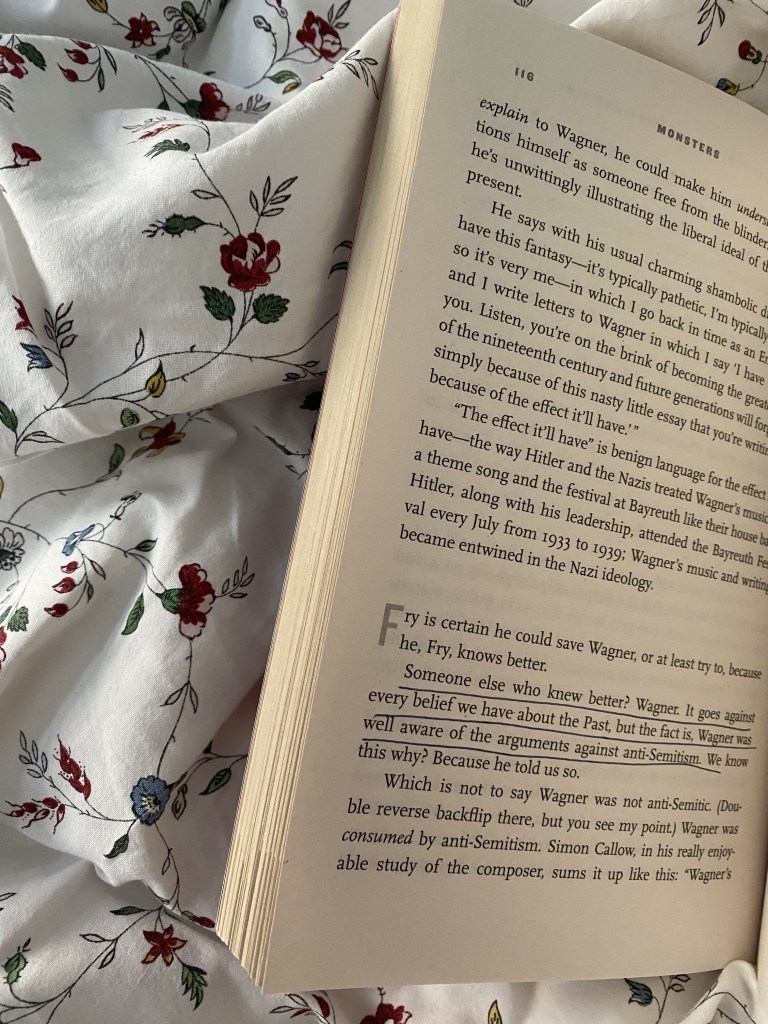
Her point is that, if we love someone’s art so much that we can’t keep ourselves from consuming it, then that’s a good thing. Because the world needs more love. We can ask why these monsters became this way, what led to them being so horrible. We can ask whose voices they have silenced, whose art we have never gotten to see. We can demand and work towards more justice and equality. But we don’t have to torture ourselves by limiting our consumption of music, books, films, artworks, photos, by shutting out the people who did bad things. Let’s focus on the joy and love we feel when reading, watching and listening to these pieces of art.
Who I Would Recommend This Book To
Literally anyone even remotely interested in art, cancel culture, society, capitalism or the concept of genius would probably really enjoy this book. Obviously, also if one of your favourite artists was or is a bit of a sorry excuse for a human being! Monsters is a really well-written book that makes it easy to fly through. It’s witty and yet full of emotions, relatable and fun to read. If you’ve been meaning to get into non-fiction books, I think this could be a great one to start with as well. But please be advised that rape, sexual and emotional abuse are discussed in this book, so if these are triggering for you, then please take care of yourself and skip this one!
So, here you go, my review of Monsters by Claire Dederer! I’d love to hear your thoughts on the question of whether or not it’s possible to separate art from artist and if you’ve read the book, whether or not you enjoyed it! ❤

 lou's library
Leave a comment